Who Are the Top Solar Battery Manufacturers in China?

China has become a central force in battery manufacturing, but “top” depends on more than factory size. The International Energy Agency’s Global Supply Chains of EV Batteries (2024) estimates that China held about 85% of global battery-cell manufacturing capacity in 2023. That figure describes capacity, not the quality or suitability of every product. Still, it shows why buyers worldwide examine Chinese suppliers closely.

The market is changing quickly. In Batteries and Secure Energy Transitions (2024), the IEA says global energy-storage capacity must grow sixfold by 2030 in its pathway to meet climate goals. Solar Battery systems will be part of that expansion, helping store daytime generation for evening use. But a strong cell alone does not make a reliable system. Buyers must also assess cycle-life evidence, safety testing, warranty terms, inverter compatibility, and after-sales support. Details matter.

This overview compares leading Chinese manufacturers by product focus, manufacturing scale, and reported track record. It also distinguishes cell makers from companies selling complete residential or commercial storage systems, since these are not interchangeable categories. Rankings can mislead. Public capacity figures may differ by source, and advertised performance is not independent verification. For that reason, the discussion treats company claims carefully and points readers toward evidence they can check. The best choice depends on application, operating conditions, and service access—not a single headline number.
Who Are the Top Solar Battery Manufacturers in China?

How China’s Solar Battery Manufacturing Industry Is Structured

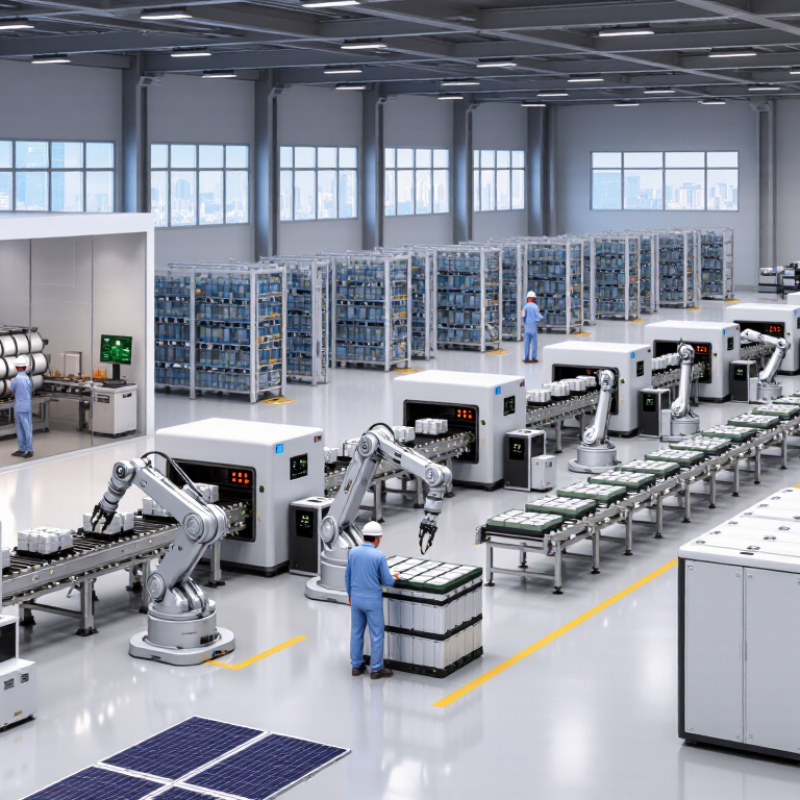
China’s solar battery industry is a layered supply chain, not a single category of factory. Upstream firms refine lithium, graphite, and other materials; cell producers turn them into battery cells. Pack makers combine cells with cooling, wiring, and safety controls. Integrators then pair storage units with inverters and energy-management software. That division matters: a cell manufacturer may not make a complete system for a rooftop or utility project.

The International Energy Agency’s Batteries and Secure Energy Transitions report (2024) estimates that China held about 85% of global battery cell manufacturing capacity in 2023.

This scale supports dense supplier networks and large production runs, but it does not mean every product performs equally in the field. Buyers still need to compare usable capacity, cycle-life test conditions, thermal management, warranties, and system compatibility. Details matter. Storage projects also depend on installers and software providers, whose work can shape performance after the battery leaves the factory. A weak point in this structure is visibility: public data often tracks cell capacity more clearly than long-term project reliability. That gap deserves more scrutiny.

What Defines a Leading Solar Battery Manufacturer

A leading solar battery manufacturer is defined by more than production volume. It must deliver stable capacity, safe thermal performance, and reliable software. The International Energy Agency reported that global energy storage capacity must increase sixfold by 2030. That target will expose weak quality systems quickly.

Strong manufacturers publish cycle-life results under clear conditions. They explain temperature ranges, depth of discharge, warranty limits, and degradation assumptions. Independent testing matters. So does traceability, from cell materials to final pack inspection. BloombergNEF reported that average lithium-ion battery pack prices fell to $115 per kilowatt-hour in 2024. Lower prices help buyers, but they can also hide compromises in testing or after-sales support. A cheap battery is not automatically efficient.

Tips: Ask for third-party safety certificates, real field data, and emergency response procedures. Check whether performance figures reflect hot, cold, and humid environments. Also review service response times, spare-part access, and software update policies. These details become important when a battery sits outdoors, behind a house, for ten years.

Manufacturing scale still matters. However, consistency matters more. A leading supplier should provide stable batch performance, transparent recall processes, and trained installation support. The International Renewable Energy Agency also highlights battery storage as essential for integrating variable solar power. Yet no scorecard is perfect. Reported cycle life may not match every household’s use. Careful buyers should compare evidence, not slogans.

Who Are the Top Solar Battery Manufacturers in China? — What Defines a Leading Solar Battery Manufacturer
Evaluation Dimension Verifiable Data Point What a Leading Manufacturer Should Demonstrate Why It Matters
Battery chemistry Lithium iron phosphate (LFP) cells have a nominal cell voltage of approximately 3.2 V. Clearly disclose the cell chemistry, cell-level specifications, and the battery’s usable energy under stated operating conditions. Chemistry and transparent specifications help buyers assess safety characteristics, system design, and application suitability.
Product safety IEC 62619 covers safety requirements for secondary lithium cells and batteries used in industrial applications, including stationary applications. Provide applicable, current test reports or certifications for the specific cell or battery model—not merely a general company-level claim. Independent evidence helps purchasers evaluate risks during normal operation and foreseeable misuse.
Energy-storage system safety IEC 63056 specifies safety requirements for lithium batteries used in electrical energy storage systems. Show how the battery design, protection functions, and system documentation address the standard’s applicable requirements. System-level suitability cannot always be inferred from cell-level test results alone.
Transport testing UN Manual of Tests and Criteria, subsection 38.3, specifies eight tests for lithium battery transport. Make the applicable UN 38.3 test summary available for the shipped battery type and configuration. Transport compliance supports safe shipment and helps buyers verify that the product has undergone required transport testing.
Performance disclosure Round-trip efficiency depends on the measurement boundary, operating conditions, and whether auxiliary loads are included. Publish the test conditions and distinguish cell, battery, and complete-system efficiency; state usable capacity and operating limits. Consistent measurement details make product comparisons meaningful and reduce the risk of misleading headline figures.
Cycle-life evidence Cycle-life results depend on factors such as depth of discharge, temperature, charge and discharge rate, and end-of-life definition. Disclose the test protocol, operating conditions, capacity-retention threshold, and supporting test evidence alongside any cycle-life claim. A cycle count without its test conditions is not a reliable basis for comparing products or estimating service life.
Quality management ISO 9001 is an international standard for quality management systems; certification applies to a defined organization and scope. Provide a valid certificate whose scope and sites are relevant to the design, manufacture, or servicing of the battery product. A relevant quality-management system supports repeatable processes, corrective action, and controlled production.
Environmental management ISO 14001 specifies requirements for an environmental management system. Document the certificate scope and provide relevant information on material sourcing, manufacturing impacts, and end-of-life handling. Environmental management and lifecycle transparency are increasingly important in responsible procurement.
Warranty and after-sales support Warranty duration, throughput limits, exclusions, and service coverage vary by product and contract; there is no single universal term. Publish the applicable warranty conditions, capacity-retention commitment, claim process, and service arrangements for the destination market. Clear terms help buyers assess long-term ownership risk and the practical availability of support.

Leading Solar Battery Manufacturers in China

Leading Solar Battery Manufacturers in China

China’s leading solar battery manufacturers serve residential, commercial, and utility-scale energy projects. Their strength comes from integrated production, including cell sourcing, battery assembly, and battery management systems. Experienced buyers inspect more than factory size. They review usable capacity, cycle performance, thermal control, and response speed. These details affect daily reliability.

A credible manufacturer should provide clear test reports, traceable materials, and documented quality procedures. Independent certification matters, but it does not replace site-specific evaluation. Published capacity can differ from usable capacity after reserve limits and temperature changes. This is often overlooked. Warranty terms also require careful reading. Some cover only selected components or operating conditions. Factory audits can reveal testing equipment, storage practices, and worker training, yet one visit cannot prove long-term performance. That uncertainty deserves attention.

Tips: Ask for cycle data at the intended depth of discharge. Check performance at low temperatures. Confirm whether installation support is available in your market. Compare round-trip efficiency using the same test conditions. Request a sample warranty before signing. Also, examine fire protection, enclosure ratings, and communication compatibility with the planned inverter. A lower purchase price may hide higher installation or maintenance costs. Real project references help, but verify them independently.

How Their Technologies and Product Portfolios Compare

Chinese solar-battery manufacturers differ in chemistry, system integration, and intended scale. The IEA’s Batteries and Secure Energy Transitions (2024) reports that China held about 85% of global battery-cell manufacturing capacity in 2023. That scale supports broad portfolios, but does not make every product equivalent. Many suppliers offer lithium iron phosphate (LFP) cells for stationary storage, while some also retain nickel-based options. LFP’s long cycle life suits frequent daily charging; actual performance still depends on temperature control and operating limits. Thermal design matters.

CNESA’s 2024 report records 21.5 GW and 46.6 GWh of newly installed energy storage in China during 2023. Against that expanding market, product ranges commonly span compact residential units, modular commercial cabinets, and containerized utility systems. Compare usable energy, continuous output, round-trip efficiency, and warranty conditions—not just advertised capacity. Inverters, battery-management software, and remote monitoring can determine how smoothly a system works with rooftop solar. Some suppliers bundle these components; others sell battery racks for integration by project contractors. The comparison is imperfect: datasheets may use different test conditions, and field performance depends on installation quality. Details matter. A claimed cycle count means little without its depth-of-discharge and temperature assumptions.

Where Chinese Solar Batteries Are Used and How the Market Is Changing

In China, solar batteries are used in homes, factories, commercial buildings, and remote power systems. A household rooftop system may store midday electricity for evening cooking, lighting, or charging. The value depends on local tariffs, roof output, and when the family uses power. It depends.

Factories and warehouses use storage to shift solar energy into later operating hours and reduce pressure from short demand peaks. In rural or remote areas, batteries can help smooth supply when sunlight changes or grid connections are limited. These systems need careful sizing; too little capacity misses useful energy, while too much can sit idle.

The market is moving beyond simple backup power. Buyers increasingly compare usable capacity, safety controls, service support, and performance over years of daily charging. Grid-connected projects also need software to coordinate batteries with solar generation and electricity demand. The details matter. Still, battery economics are not equally attractive everywhere: power prices, weather, installation quality, and maintenance all shape the outcome. Recycling and end-of-life planning deserve more attention, too. A low purchase price alone does not show whether a system will serve its users well.

Contact Details

Address:

Solar Pump Solutions,
Borrisokane, Co. Tipperary, Ireland.

Phone:

+353 86 1216312

Email:

sale@desasolar.com

Connect with us

Scroll to Top
Solar Pump Solutions
Privacy Overview

This website uses cookies so that we can provide you with the best user experience possible. Cookie information is stored in your browser and performs functions such as recognising you when you return to our website and helping our team to understand which sections of the website you find most interesting and useful.