
Why Choose a Surface Water Pump for Global Projects?
Global water projects rarely operate under simple conditions. Rivers shift with seasons. Reservoirs collect silt. Intake points may sit far from reliable power. These realities make equipment selection more than a purchasing decision.
A Surface Water Pump offers practical access to rivers, lakes, canals, and storage basins. It can support irrigation, municipal supply, construction, flood control, and emergency response. The right model can move large volumes efficiently. It can also simplify installation near accessible water sources. However, performance depends on more than flow rate. Engineers must examine total head, suction lift, debris levels, temperature, corrosion, and maintenance access. A pump that performs well in a clear reservoir may struggle in a muddy river.
Water expert Peter H. Gleick has written, “Water is the most precious, limited, and contested resource on Earth.” That perspective matters for international projects. Every wasted kilowatt, failed seal, or delayed repair can affect communities and budgets. Field experience shows that local operators need clear controls, replaceable components, and practical training. Sophisticated equipment is not always the most reliable choice.
No pump is universal. That assumption can fail.
A dependable Surface Water Pump should match the site, climate, water quality, and service capacity. Designers should also question optimistic data. Seasonal tests may reveal lower intake levels or heavier debris than early surveys suggested. Careful selection creates resilience, but only when engineering judgment remains open to revision.
What Is a Surface Water Pump and How Does It Work?
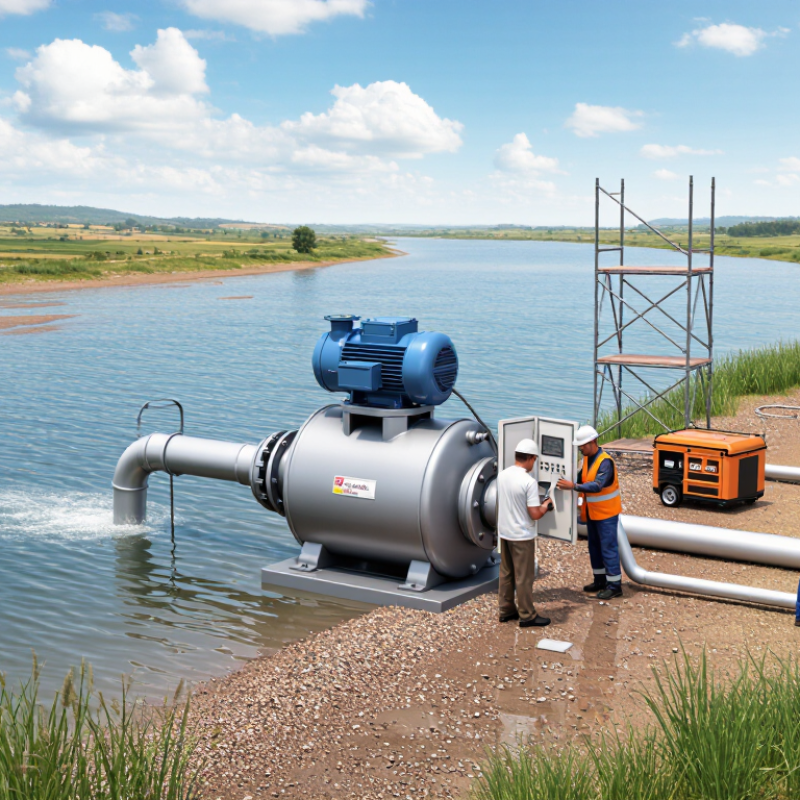
A surface water pump draws water from an open source, such as a river, lake, reservoir, or tank. It usually sits above the waterline. A suction pipe carries water into the casing, while an impeller spins and creates pressure. The discharge pipe then sends water toward treatment units, storage tanks, or irrigation networks. Simple in principle. Correct installation is not.
FAO AQUASTAT reports that agriculture accounts for about 70% of global freshwater withdrawals. This figure explains why reliable surface-water equipment matters in farming and infrastructure projects. However, a pump must match the site. Engineers check flow rate, total head, pipe length, water temperature, and suspended solids. If the suction lift is excessive, cavitation may damage the impeller. A pump can move water and still waste energy. The U.S. Department of Energy identifies pumping systems as major industrial electricity users, making efficiency a practical project concern.
In muddy river water, a screened intake helps limit leaves, sand, and small debris. Operators should inspect seals, bearings, and suction lines regularly. The 2024 United Nations World Water Development Report notes that billions still lack safely managed drinking water, increasing pressure on dependable water systems. Surface pumps can support temporary and permanent supply networks, but they are not universal solutions. Flood levels change. Water quality changes. A design based on yesterday’s conditions may fail during the next dry season. Careful field testing remains essential.
Why Choose a Surface Water Pump for Global Projects?
A surface water pump draws water from accessible sources such as rivers, lakes, reservoirs, and open tanks. It is commonly selected for irrigation, municipal supply, construction, and industrial water transfer because it is easy to inspect, maintain, and adapt to different flow requirements.
The chart shows widely cited global freshwater withdrawal shares by sector: agriculture accounts for approximately 69%, industry for 19%, and municipal use for 12%. These sectoral requirements explain why surface water pumps are frequently used for large-volume water transfer and distribution projects.
Data reference: FAO AQUASTAT global estimates; percentages are rounded and may vary by year and methodology.
Which Global Water Applications Need Surface Water Pumps?
Surface water pumps serve projects that draw from rivers, canals, ponds, reservoirs, and open tanks. They suit locations where water must move quickly across changing work areas. In agricultural regions, these pumps support irrigation during dry weeks, filling storage tanks and feeding sprinkler lines. They also help construction crews drain shallow pits, remove rainwater, and supply mixing water from approved sources. Not always.
Municipal teams use them for raw-water transfer, temporary bypasses, and emergency drainage after intense storms. During storms. Flood-prone communities may place trailer-mounted units near streets, underpasses, or low riverbanks.
In aquaculture, a controlled pump can circulate pond water, but flow must match oxygen levels and stocking conditions. Industrial sites may use surface pumps for washdown or process water, after checking intake quality and discharge requirements.
Field judgment matters here. A high-flow unit can still fail when the lift is underestimated or debris blocks the strainer.
Project engineers should compare total head, flow rate, solids, power access, and local maintenance skills. Cold weather, sand, unstable voltage, and limited spare parts can change the decision.
Field technicians often report delays when operators receive equipment without practical training. A clearer manual would help. Reliable installations include guards, suitable hoses, backup plans, and routine checks for leaks, vibration, and overheating. The pump must also match the water source, distance, duty cycle, and actual conditions on site.
What Benefits Make Surface Water Pumps Suitable for Projects?
Why Choose a Surface Water Pump for Global Projects?
Surface water pumps offer practical access to rivers, reservoirs, tanks, and shallow intake points. Their above-ground layout allows technicians to inspect seals, couplings, and filters without entering a well. That matters where spare parts and specialist labor are limited. The WHO/UNICEF Joint Monitoring Programme reported that 2.2 billion people lacked safely managed drinking water in 2022. Reliable, serviceable pumping equipment remains essential for expanding local water access.
These pumps also support irrigation, construction, drainage, and emergency supply systems. FAO data indicates that agriculture accounts for about 70% of global freshwater withdrawals. A surface pump can move large volumes efficiently when the water source is nearby and the suction lift is carefully controlled. Modular installation makes capacity changes easier. Transport is often simpler, too. In remote projects, those details reduce downtime.
However, suitability is never automatic. Raw surface water may contain silt, algae, or debris, so intake screens and pre-filtration need regular attention. Excessive suction height can cause cavitation and unstable flow. That assumption can fail. Project teams should verify seasonal water levels, pipe friction, power quality, and local maintenance skills before selection. The World Bank’s “Water Supply, Sanitation, and Hygiene” monitoring work also highlights the importance of sustainable operation, not only initial access. Lower installation complexity helps, but careless sizing still wastes energy and shortens equipment life.
Why Choose a Surface Water Pump for Global Projects? - What Benefits Make Surface Water Pumps Suitable for Projects?
| Project Consideration | Typical Surface Water Pump Data | Benefit for Global Projects | Practical Application Notes |
|---|---|---|---|
| Water Sources | Rivers, canals, reservoirs, open tanks, construction pits, and rainwater collection basins | Suitable for infrastructure, irrigation, drainage, municipal, mining, and emergency water-transfer projects | The intake should include an appropriate strainer and should be positioned above sediment whenever possible |
| Flow Capacity | Common project configurations range from approximately 10 to 1,000 m³/h; final capacity depends on pump size and system resistance | One pump family can support small dewatering tasks as well as large-scale water transfer | The required flow should be calculated from demand, filling time, drainage rate, or irrigation scheduling |
| Head and Pressure | Typical project duties range from approximately 10 to 100 m of total dynamic head, depending on the pump and piping system | Can handle long pipelines, elevation changes, sprinklers, filtration units, and pressurized distribution networks | Total dynamic head must include static lift, pipe friction, fittings, valves, and terminal pressure requirements |
| Suction Lift | The theoretical maximum suction lift for water at sea level is about 10.3 m; practical installations are commonly limited to approximately 7–8 m because of losses and cavitation risk | Allows the pump to remain accessible on land while drawing water from a nearby source | Higher elevations, warmer water, long suction lines, and restrictive strainers reduce the allowable suction lift |
| Maintenance Access | Motor, coupling, seals, valves, and control components remain accessible above ground | Inspection, cleaning, seal replacement, and troubleshooting can generally be completed without lifting equipment from the water | A dry, ventilated, and protected installation area should be provided for safe servicing |
| Installation Flexibility | Available as horizontal, vertical, end-suction, split-case, self-priming, diesel-driven, or electrically driven configurations | Supports different site layouts, power conditions, portability requirements, and duty cycles | Portable skids or trailer-mounted units are useful for temporary construction and emergency response applications |
| Power Options | Electric motors are common; diesel engines can be used where grid power is unavailable or unreliable | Improves adaptability across regions with different grid reliability, voltage standards, and fuel availability | Electrical protection, grounding, ventilation, fuel storage, and local emissions requirements must be considered |
| Water Quality Tolerance | Pump selection can be matched to clean water, moderately turbid water, or abrasive service through suitable materials and impeller design | Provides design flexibility for agricultural, civil engineering, flood-control, and industrial water applications | Large solids, sand concentration, chemical content, and temperature must be checked before selection |
| Energy Performance | Pump efficiency varies by design and operating point; many medium and large centrifugal pumps operate within an approximate 60–85% hydraulic efficiency range | Correct sizing can reduce energy consumption and operating costs over long project lifecycles | The best efficiency is normally achieved near the pump’s best efficiency point; throttling and oversizing should be minimized |
| Climate and Site Conditions | Can be installed in hot, cold, dusty, humid, or coastal environments when the motor enclosure, materials, and protection level are correctly specified | Suitable for varied international project environments and seasonal operating conditions | Consider corrosion protection, freeze protection, enclosure rating, altitude derating, and foundation stability |
| Best-Fit Project Types | Irrigation, municipal water transfer, flood drainage, construction dewatering, fire-water systems, industrial circulation, and reservoir management | Combines accessible maintenance, scalable capacity, flexible power selection, and broad installation options | Final selection should be based on the duty point, water properties, suction conditions, operating hours, local standards, and lifecycle cost |
Note: The performance ranges shown are general engineering reference values. Actual results depend on pump design, operating point, water temperature, elevation, pipework, materials, and site conditions.
How Should Pump Capacity and System Design Be Selected?
Why Choose a Surface Water Pump for Global Projects?
How Should Pump Capacity and System Design Be Selected?
Surface water pumps suit irrigation, construction, emergency supply, and municipal projects. They draw from rivers, reservoirs, canals, or temporary storage tanks. Their accessible installation makes inspection easier. Operators can often observe intake conditions directly. That matters when water levels change quickly.
Capacity should match the real duty point, not the largest possible demand. Measure required flow, total head, pipe length, elevation, and daily operating hours. Include friction losses from bends, valves, filters, and check devices. A practical design also allows limited future growth. Oversizing may increase energy use and cause unstable operation. Undersizing creates pressure shortages and excessive running time. Small errors become expensive at remote sites.
System design must consider water quality and seasonal conditions. Screens should control debris without creating excessive inlet losses. The suction line needs a short, straight route where possible. Confirm available NPSH before final selection. Check motor protection, dry-run control, weather exposure, and local electrical requirements. Materials should match salinity, sediment, and temperature. Field measurements are valuable, yet they are not always complete. I have seen designs rely on one dry-season reading, then struggle during heavy rain. Rechecking assumptions before procurement is less convenient, but safer. Test the pump at several operating points, record vibration and pressure, and keep those records for maintenance decisions.
What Factors Affect Installation, Operation, and Maintenance?
Choosing a surface water pump for global projects requires more than checking flow rate. Installation conditions often decide long-term performance. A river intake may face mud, floating debris, seasonal flooding, or rapid water-level changes. Measure the static lift, pipe length, friction loss, and required discharge before selecting equipment. Our first project estimate was too optimistic because sediment loading was underestimated. That mistake increased cleaning work during the first operating season.
The foundation must remain level and strong enough to control vibration. Keep the suction pipe short, straight, and fully supported. Poor alignment can create leaks and damage bearings. Confirm the available voltage, phase, frequency, and backup power before commissioning. In remote areas, trained local operators matter as much as technical specifications. They should check unusual noise, pressure changes, seal leakage, and motor temperature during each shift. Small warning signs matter.
Maintenance depends on water quality and access. Inspect strainers and intake screens more often when algae or sand is present. Flush sediment from low points in the piping system. Record flow, pressure, energy use, and maintenance dates in a simple log. These records reveal gradual wear better than memory. Spare seals, bearings, gauges, and fasteners should match verified dimensions, not assumptions. Climate also affects service intervals. Heat, freezing conditions, humidity, and salt air can shorten component life. We still review the schedule after real operating data arrives. Field conditions rarely follow the original plan.
Related Posts
-
What is a Solar Pond Pump and How Does It Improve Water Quality and Ecosystem Health
-
Unlocking Efficiency: The Advantages of Solar Panel Water Pumps for Sustainable Water Solutions
-
Exploring Real Life Applications of Best Solar Pumps in Agriculture and Industry
-

Exploring the Surge of Solar Pumps Demand at the 137th Canton Fair: Insights and Opportunities
-
5 Best Solar Systems that Will Power Your Home Efficiently
-

How to Choose the Best Water Solar Panel for Efficient Energy Solutions
Contact Details
Address:
Solar Pump Solutions,
Borrisokane, Co. Tipperary, Ireland.
