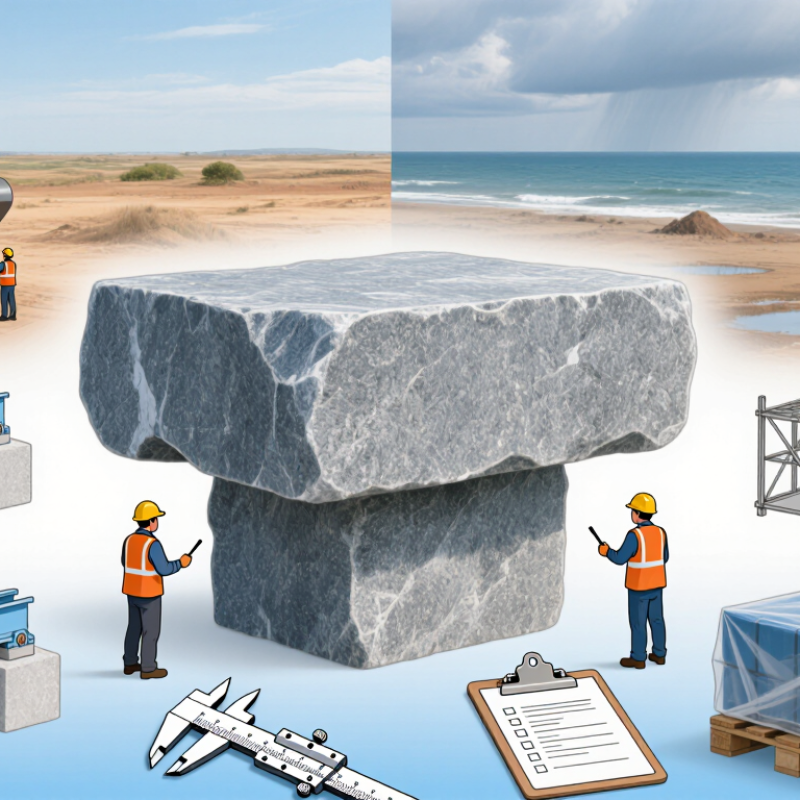
Why Choose Granite Support Blocks for Global Projects?
Global construction projects demand support materials that perform reliably across changing climates, transport conditions, and installation practices. granite support blocks offer a practical foundation for heavy equipment, structural components, and temporary site systems. Their dense mineral structure provides strong load resistance and good dimensional stability. These qualities matter when a project moves from a dry inland site to a humid coastal environment.
Performance begins with correct selection. Engineers must review load calculations, block dimensions, surface condition, and contact pressure before approval. A support block is not automatically suitable for every application. Granite quality, quarry source, cutting accuracy, and visible defects can affect service performance. That detail is easy to overlook.
On international projects, consistency becomes equally important. Reliable suppliers should provide technical data, inspection records, and clear packaging information. They should also understand lifting limits and long-distance shipping risks. A chipped edge may seem minor, but it can complicate alignment during installation. Experienced teams inspect each granite support blocks shipment before use and document any concerns.
Field conditions can challenge even a well-designed solution. Uneven ground, poor drainage, or incorrect leveling may reduce stability. Therefore, project managers should combine material knowledge with site-specific engineering advice. Granite can be durable, but it is not a substitute for proper design. That distinction deserves attention.
Choosing granite support blocks can support safer, more predictable global construction outcomes. The best decision balances strength, workmanship, logistics, and verified project requirements. Through careful planning and honest evaluation, teams can reduce avoidable delays while improving long-term reliability.
What Are Granite Support Blocks and How Are They Made?
Granite support blocks are load-bearing pieces placed beneath beams, machinery, pipes, or precast units. They transfer pressure into a stable foundation and reduce point loading. Unlike ordinary concrete blocks, granite offers high compressive strength, low water absorption, and strong resistance to abrasion. The U.S. Geological Survey’s Mineral Commodity Summaries 2024 reported approximately 1.8 million metric tons of dimension stone production in the United States during 2023. That volume reflects continuing demand for carefully processed natural stone.
Manufacturing begins with quarry inspection. Technicians check grain structure, fractures, and visible weathering before cutting large granite blocks with diamond wire saws. Computer-controlled saws then produce uniform sections. Each support block is calibrated, chamfered, and surface-finished for stable contact. Testing commonly follows methods such as ASTM C97, which evaluates absorption and strength. Dimensions are also checked with gauges, not visual judgment.
Details matter.
A rough underside can create uneven loading. A polished surface may also reduce grip in wet conditions. Natural Stone Institute guidance stresses selecting finishes according to service exposure, not appearance alone. For international projects, engineers should verify local bearing calculations, frost conditions, lifting points, and transport packaging. USGS production data cannot predict performance at one construction site. That is where project-specific testing remains necessary. Granite is durable, but it is not automatically suitable for every load or climate.
Key Properties That Suit Granite Support Blocks for Global Projects
Granite support blocks suit global projects because their key properties remain dependable under demanding site conditions. Their high compressive strength helps carry concentrated loads from equipment, frames, and structural assemblies. Dense mineral structure limits water absorption, reducing damage during repeated wet and dry cycles. Granite also resists abrasion and many outdoor temperature changes. On a coastal foundation, a properly finished block can provide a stable bearing surface and reduce replacement frequency. Performance still depends on grade, finish, and installation quality.
Tips: Confirm compressive strength, density, water absorption, and dimensional tolerances before approval. Ask for recent laboratory reports and traceable quarry documentation. Match the block size to the calculated load, not a rough visual estimate. Check the bearing surface for chips, unevenness, and contamination. In cold regions, review freeze-thaw data. In hot regions, allow for thermal movement in connected materials. Small errors matter. A level survey and calibrated tools can prevent costly alignment problems.
For international procurement, consistent geometry is as important as raw strength. Standardized dimensions simplify packing, lifting, and replacement across different sites. Granite can support long service intervals, which may reduce maintenance travel and handling costs.
However, transport weight increases shipping demands, and local engineering rules may differ. Granite is not a universal answer. A strong block can still fail when access, lifting equipment, or drainage is overlooked. Specifications should state testing methods, tolerances, surface finish, and installation conditions.
Common Engineering and Construction Applications
Why Choose Granite Support Blocks for Global Projects?
Granite support blocks serve many engineering and construction applications. Their high compressive strength supports heavy equipment, structural frames, bridge components, and prefabricated concrete units. Their dense structure also resists moisture, abrasion, and temperature changes. This matters on coastal sites, exposed rail corridors, and industrial foundations.
In machine installations, granite blocks can create stable bearing points beneath presses, generators, compressors, and precision equipment. Surveying teams may use accurately cut blocks for instrument bases and alignment platforms. Civil contractors also place them beneath temporary supports, modular buildings, and large storage systems. Each application still requires verified load calculations, level checks, and suitable contact surfaces. Granite is durable, but it is not automatically the best choice. Poor bedding can transfer stress unevenly. A strong block can still fail in a weak assembly.
Tips: Confirm the block’s dimensions, surface flatness, stone quality, and certified load capacity. Inspect edges for chips before placement. Use a designed leveling layer where the ground is uneven. Keep drainage paths open around outdoor supports. Small errors become expensive later.
Global projects often involve different standards, climates, and installation skills. Clear drawings and inspection records reduce confusion between suppliers and site crews. Engineers should also review lifting points and transport risks before delivery. Granite can crack if dropped, despite its apparent toughness. That detail is easy to overlook. Local site conditions may expose assumptions that looked reasonable on paper. Careful review remains essential.
How to Select the Right Granite Support Block
Why Choose Granite Support Blocks for Global Projects?
How to Select the Right Granite Support Block
Selecting a granite support block starts with the actual load, not the catalogue photograph. Record the equipment weight, contact area, vibration level, and expected service life. A block supporting a precision machine needs different control than one supporting a structural frame. Measure twice. Small gaps matter.
Check the granite’s compressive strength, density, water absorption, and thermal stability through reliable test reports. Inspect each surface for cracks, chipped edges, mineral seams, and uneven polishing. Flatness and parallelism should match the project tolerance. For outdoor work, consider freeze-thaw cycles, rain exposure, salt, and sudden temperature changes. Dark granite may absorb more solar heat, although color alone cannot confirm performance.
Dimensions must allow safe handling and accurate placement. Leave enough clearance for anchors, shims, drainage, and future inspection. Confirm local lifting requirements before delivery; a dense block can become a serious handling problem. On site, use a calibrated level and check the supporting foundation before installation. Do not rely only on a visual fit. A block can look stable while carrying pressure on one corner. That is a costly detail. Selection documents should identify stone origin, test methods, tolerances, batch information, and inspection responsibilities. Specifications are useful, but they are not perfect. Field conditions can expose assumptions that were missed during design.
International Standards, Shipping, and Project Considerations
Granite support blocks suit global projects because they combine high compressive strength, dimensional stability, and resistance to moisture. Engineers should verify each block against local requirements, not rely on appearance alone. ASTM C615 covers granite dimension stone, while ASTM C170 measures compressive strength. European projects may reference EN 1341 and EN 12372 for stone performance and flexural strength. These standards do not replace structural design. Load paths, bearing areas, vibration, and temperature changes still require professional review.
Shipping can change the installation plan. The 2023 UNCTAD Review of Maritime Transport states that over 80% of global merchandise trade by volume moves by sea. Granite is dense, so incorrect crate design can increase freight costs and handling risks. Use measured weights, protected corners, moisture-resistant packaging, and clear lifting points. The World Bank’s 2023 Logistics Performance Index emphasizes customs efficiency, shipment reliability, and delivery timeliness. Therefore, export documents should match the actual block count, dimensions, and weight. Small errors become expensive at ports.
Site conditions need equal attention. A block may pass a factory test but fail on uneven soil or poor drainage. It happens. Specify tolerances, foundation preparation, anchoring details, and inspection records before shipment. Allow space for forklifts and local lifting equipment. Project teams should also confirm regional safety rules and testing methods. One overlooked issue is replacement supply. Keeping approved dimensions and test records helps local engineers reproduce the solution when delays occur. Perfect planning is unlikely, but transparent verification makes problems manageable.
| Evaluation Area | Data Dimension | Relevant Fact or Project Guidance | Global Project Consideration |
|---|---|---|---|
| Material Performance | Compressive strength | Granite is a high-strength natural stone. The specified compressive-strength value should be taken from the test report for the exact quarry source, grade, and finished product rather than assumed from the stone name alone. | Use the tested value together with the design safety factor, contact area, eccentric loading, and the supporting substrate capacity. |
| Material Performance | Water absorption | Water absorption varies by granite type and processing. Lower absorption generally supports better resistance to moisture-related staining and freeze-thaw exposure, but it does not eliminate the need for correct drainage and detailing. | Request a lot-specific test result when blocks will be used outdoors, in wet environments, or in climates with repeated freezing and thawing. |
| Material Performance | Dimensional stability | Granite has low moisture movement compared with many porous construction materials. Dimensional tolerances still depend on the cutting, grinding, and inspection method. | Define length, width, height, squareness, flatness, edge condition, and allowable tolerance before production. |
| International Standards | ASTM C615 | ASTM C615 covers granite dimension stone and addresses requirements such as physical properties, workmanship, finish, and sampling. It should be referenced only where the project specification adopts ASTM requirements. | Confirm the required edition and whether the project requires additional structural, slip-resistance, chemical-resistance, or freeze-thaw testing. |
| International Standards | ASTM C97, ASTM C170, and ASTM C880 | ASTM C97 is used for absorption and bulk specific gravity; ASTM C170 addresses compressive strength; ASTM C880 addresses flexural strength of dimension stone. These tests measure different properties and are not interchangeable. | Match each test to the actual load case. A compressive-strength result alone does not verify resistance to bending, impact, or point loading. |
| International Standards | European specification route | EN 1341 addresses natural stone paving slabs and may be relevant to paving applications. Other European applications can require different product standards, national annexes, or project-specific testing. | Ask the engineer or authority having jurisdiction to identify the applicable harmonized or national standard before ordering. |
| Design & Safety | Load-bearing area | Design capacity depends on the actual bearing area, load distribution, block geometry, surface flatness, edge distance, and the strength of adjacent materials. | Avoid relying on nominal block size alone. Provide calculations for concentrated loads, uneven contact, and potential edge breakout. |
| Design & Safety | Outdoor and freeze-thaw exposure | Granite selection for freezing climates should consider water absorption, freeze-thaw test requirements, drainage, joint design, and exposure severity. | Do not seal trapped water inside the assembly. Confirm that the selected test method and acceptance criteria match the climate and installation detail. |
| Fabrication | Typical custom dimensions | Support blocks are commonly produced to project-specific dimensions. Practical sizes may range from small pieces around 100 × 100 × 50 mm to larger engineered pieces exceeding 300 mm in one dimension, depending on load and handling requirements. | Finalize shop drawings before cutting. Larger blocks increase mass, handling requirements, packaging needs, and freight cost. |
| Fabrication | Surface finish | Available finishes may include sawn, honed, flamed, or polished surfaces. The finish affects friction, appearance, cleanability, and contact behavior. | Specify the finish separately for visible faces and bearing faces. Bearing faces generally require controlled flatness rather than decorative polishing. |
| Quality Control | Inspection documents | A project quality package may include dimensional inspection records, material identification, photographs, packing lists, test reports, and a certificate of conformity when required. | Agree on inspection points, sampling frequency, rejection criteria, and document language before production begins. |
| Packaging | Export wooden packaging | Wooden crates, skids, and pallets used in international trade commonly need to comply with ISPM 15 treatment and marking requirements. The requirement applies to qualifying wood packaging material, not to the granite itself. | Use suitable treated wood, maintain visible marks, protect finished surfaces, and verify destination-country customs rules before dispatch. |
| Shipping | Weight and volume planning | Granite density is commonly planned at approximately 2,600–2,800 kg/m³ for preliminary logistics calculations. The certified or measured density of the selected material should control final calculations. | Calculate net stone weight, crate weight, total gross weight, package dimensions, center of gravity, and lifting points before booking transport. |
| Shipping | Container utilization | Granite is often weight-limited before it is volume-limited. Actual allowable cargo weight depends on the container specification, carrier rules, route, road regulations, and terminal restrictions. | Request a carrier-approved packing plan. Do not use a generic container payload figure for final shipment approval. |
| Shipping | Handling and securing | Stone blocks should be immobilized against sliding, impact, tipping, and abrasion. Blocking, bracing, cushioning, and lifting equipment must be suitable for the calculated mass. | Provide handling instructions and package marks showing gross weight, lifting orientation, center of gravity where relevant, and fragile finished surfaces. |
| Trade & Customs | Product classification | Natural stone classification can depend on whether the item is crude, roughly trimmed, cut, sawn, or further worked. The correct customs code must be confirmed for the exact product form and destination. | Use accurate commercial descriptions, material type, dimensions, quantity, net weight, gross weight, origin, and customs classification on shipping documents. |
| Trade & Customs | Incoterms and insurance | Incoterms define selected delivery responsibilities, costs, and risk transfer, but they do not replace a freight contract, cargo insurance policy, or technical acceptance specification. | State the agreed Incoterms rule and named place, clarify unloading responsibility, and confirm insurance coverage for breakage and concealed damage. |
| Installation | Substrate compatibility | Granite should bear on a clean, stable, and adequately strong substrate. Mortar, bedding compounds, isolation layers, and drainage details must be compatible with the design loads and exposure conditions. | Check differential movement, chemical compatibility, moisture paths, tolerances, and access for replacement or future maintenance. |
| Project Management | Lead time and approvals | Custom quarry selection, sample approval, testing, fabrication, export packing, port handling, and international transit can each affect the delivery schedule. | Allow time for technical submittals, first-article approval, independent inspection, customs clearance, and potential port or weather delays. |
| Sustainability | Service life and maintenance | Granite can provide long service life when correctly selected and detailed. Routine maintenance generally focuses on cleaning, drainage, joint condition, and inspection for cracking or movement. | Evaluate whole-life performance rather than purchase price alone, including replacement access, transport distance, packaging, and end-of-life reuse potential. |

Article Source:
Contact Details
Address:
Solar Pump Solutions,
Borrisokane, Co. Tipperary, Ireland.